


Non-immune Function of B Cells Uncovered in Cell: Interorgan Metabolic Regulation of Physical Exercise Capacity
Source:Jiang Peng
2026-06-18
On April 17, 2026, the research team led by Associate Professor Jiang Peng from Tsinghua University’s School of Life Sciences and Tsinghua-Peking Joint Center for Life Sciences published a study in Cell, titled B-cell deficiency limits exercise capacity by remodeling liver glutamate metabolism. This work identifies a non-immune function of B cells and a metabolite-mediated liver-skeletal muscle regulatory pathway. The team also introduces a new concept "immunoexercise" to describe the modulation of exercise capacity by immune cells and the immune system. This research was interviewed and reported by Nature News. A preview article named B cells just got a workout was also published in the same issue of Cell to highlight this study.
As a key component of adaptive immunity, B cells are essential components for humoral immunity, mediating antibody production, antigen presentation and immune regulation. Abnormal activation, proliferation or differentiation of B cells is linked to autoimmune diseases and B-cell malignancies. Currently, B cell-targeted therapies such as anti-CD20 antibody rituximab are widely used for treating B-cell lymphoma, chronic lymphocytic leukemia and autoimmune diseases. However, all reported possible physiological and pathological functions of B cells are limited to immune regulation to date.
Exercise capacity is a vital marker of physical health, relying on coordinated functions of skeletal muscle, cardiovascular and respiratory systems. Previous studies have proven that exercise regulates immune function via myokines, whereas the reverse modulation of exercise capacity by the immune system remains poorly understood. After genetic knockout and antibody-mediated B cell depletion in mice, mice exhibited significantly decreased running endurance, rotarod performance, spontaneous activity and grip strength, along with reduced energy metabolism and impaired mitochondrial quality and biogenesis in skeletal muscle. No obvious changes in body weight or cardiac function were detected, suggesting that declined exercise capacity stems from systemic metabolic disorders.
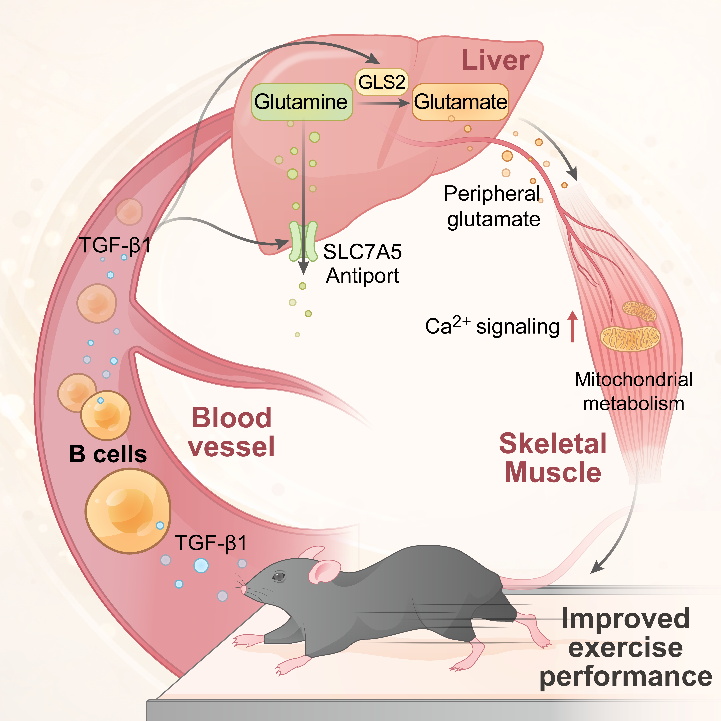
Mechanistic results show that B cell deletion induces amino acid metabolic reprogramming and reduces glutamate levels in serum and skeletal muscle. This study focuses on conventional B cells rather than rare tissue-resident B cell subsets. Further experiments demonstrate that reduced B cell-derived TGF-β1 downregulates hepatic GLS2 and SLC7A5 expression, remodels liver glutamate metabolism, and accounts for decreased peripheral glutamate levels. Reduced skeletal muscle glutamate causes two adverse effects: disrupting Ca²⁺ oscillation and inhibiting CaMK signaling pathway to block muscle contraction signals; impairing mitochondrial quantity, cristae structure and electron transport chain function to suppress muscular energy metabolism. Therefore, glutamate, as a key interorgan metabolic signal, is essential for maintaining normal exercise capacity via liver-muscle metabolic distribution.
This study reveals a B cell TGF-β1-dependent liver-skeletal muscle metabolic axis controlling host exercise capacity. It uncovers immune-independent functions of B cells, expands the functional scope of B lymphocytes, and provides a new research direction for non-canonical immune function. It proves that B cells regulate distal organ metabolism remotely via metabolites beyond immune defense. This finding demonstrates the active regulation of exercise capacity by the immune system, and revises the traditional view that the immune system is only passively modulated by exercise.
The School of Life Sciences and Tsinghua-Peking Joint Center for Life Sciences, Tsinghua University serve as both first and corresponding author affiliations. Associate Professor Jiang Peng is the sole corresponding author. Dr. Youxiang Mao (postdoctoral fellow), Ziyan Xia (2023 PhD candidate) from the School of Life Sciences, and Xu Pan (2023 PhD candidate) from the School of Basic Medical Sciences are co-first authors. This work was supported by the Tsinghua-Peking Center for Life Sciences, the National Natural Science Foundation of China and the Tsien Tang Life Science Development Fund.
Article link: https://www.cell.com/cell/fulltext/S0092-8674(26)00340-5
As a key component of adaptive immunity, B cells are essential components for humoral immunity, mediating antibody production, antigen presentation and immune regulation. Abnormal activation, proliferation or differentiation of B cells is linked to autoimmune diseases and B-cell malignancies. Currently, B cell-targeted therapies such as anti-CD20 antibody rituximab are widely used for treating B-cell lymphoma, chronic lymphocytic leukemia and autoimmune diseases. However, all reported possible physiological and pathological functions of B cells are limited to immune regulation to date.
Exercise capacity is a vital marker of physical health, relying on coordinated functions of skeletal muscle, cardiovascular and respiratory systems. Previous studies have proven that exercise regulates immune function via myokines, whereas the reverse modulation of exercise capacity by the immune system remains poorly understood. After genetic knockout and antibody-mediated B cell depletion in mice, mice exhibited significantly decreased running endurance, rotarod performance, spontaneous activity and grip strength, along with reduced energy metabolism and impaired mitochondrial quality and biogenesis in skeletal muscle. No obvious changes in body weight or cardiac function were detected, suggesting that declined exercise capacity stems from systemic metabolic disorders.
Mechanistic results show that B cell deletion induces amino acid metabolic reprogramming and reduces glutamate levels in serum and skeletal muscle. This study focuses on conventional B cells rather than rare tissue-resident B cell subsets. Further experiments demonstrate that reduced B cell-derived TGF-β1 downregulates hepatic GLS2 and SLC7A5 expression, remodels liver glutamate metabolism, and accounts for decreased peripheral glutamate levels. Reduced skeletal muscle glutamate causes two adverse effects: disrupting Ca²⁺ oscillation and inhibiting CaMK signaling pathway to block muscle contraction signals; impairing mitochondrial quantity, cristae structure and electron transport chain function to suppress muscular energy metabolism. Therefore, glutamate, as a key interorgan metabolic signal, is essential for maintaining normal exercise capacity via liver-muscle metabolic distribution.
Figure. B cells maintain exercise performance via immune-independent regulation of hepatic glutamate metabolism.
This study reveals a B cell TGF-β1-dependent liver-skeletal muscle metabolic axis controlling host exercise capacity. It uncovers immune-independent functions of B cells, expands the functional scope of B lymphocytes, and provides a new research direction for non-canonical immune function. It proves that B cells regulate distal organ metabolism remotely via metabolites beyond immune defense. This finding demonstrates the active regulation of exercise capacity by the immune system, and revises the traditional view that the immune system is only passively modulated by exercise.
The School of Life Sciences and Tsinghua-Peking Joint Center for Life Sciences, Tsinghua University serve as both first and corresponding author affiliations. Associate Professor Jiang Peng is the sole corresponding author. Dr. Youxiang Mao (postdoctoral fellow), Ziyan Xia (2023 PhD candidate) from the School of Life Sciences, and Xu Pan (2023 PhD candidate) from the School of Basic Medical Sciences are co-first authors. This work was supported by the Tsinghua-Peking Center for Life Sciences, the National Natural Science Foundation of China and the Tsien Tang Life Science Development Fund.
Article link: https://www.cell.com/cell/fulltext/S0092-8674(26)00340-5
