

Pengyan Xia and Shuo Wang’s Team Discovers CTH as an Intracellular Pattern Recognition Receptor Activating Noncanonical Inflammasome
Source:Pengyan Xia
2026-06-18
On April 30, 2026, a collaborative study by the team of Professor Pengyan Xia from the School of Basic Medical Sciences at Peking University and the team of Professor Shuo Wang from the Institute of Microbiology, Chinese Academy of Sciences, was published in Nature Immunology under the title "Cytosolic CTH senses bacterial lipoproteins and drives noncanonical inflammasome activation." This study reports a novel mechanism by which cystathionine γ lyase (CTH), a sulfur containing amino acid metabolic enzyme, acts as an intracellular pattern recognition receptor that recognizes bacterial lipoproteins and initiates noncanonical inflammasome activation through its hydrolase activity. This discovery expands our understanding of the immune recognition functions of metabolic enzymes and provides new targets for therapeutic intervention in anti infectious immunity.
Bacterial lipoproteins are an important class of pathogen associated molecular patterns. The highly conserved N terminal lipidated cysteine residues anchor them to the bacterial cell membrane. Extracellular recognition of these lipoproteins is well established to be mediated by Toll like receptor 2 (TLR2) on the cell surface. However, whether there are receptors within the cytosol that directly sense bacterial lipoproteins remains a key unsolved question in the field of innate immunity.
Using functional screening and CRISPR/Cas9‑based gene‑knockout approaches, the team identified CTH as an essential mediator of bacterial lipoprotein induced noncanonical inflammasome activation. In CTH‑deficient macrophages, bacterial lipoprotein stimulation failed to trigger caspase‑11 cleavage, GSDMD mediated pyroptosis, or cytokine secretion, whereas the TLR2 downstream NF‑κB pathway was unaffected, suggesting that CTH specifically regulates the noncanonical inflammasome pathway.
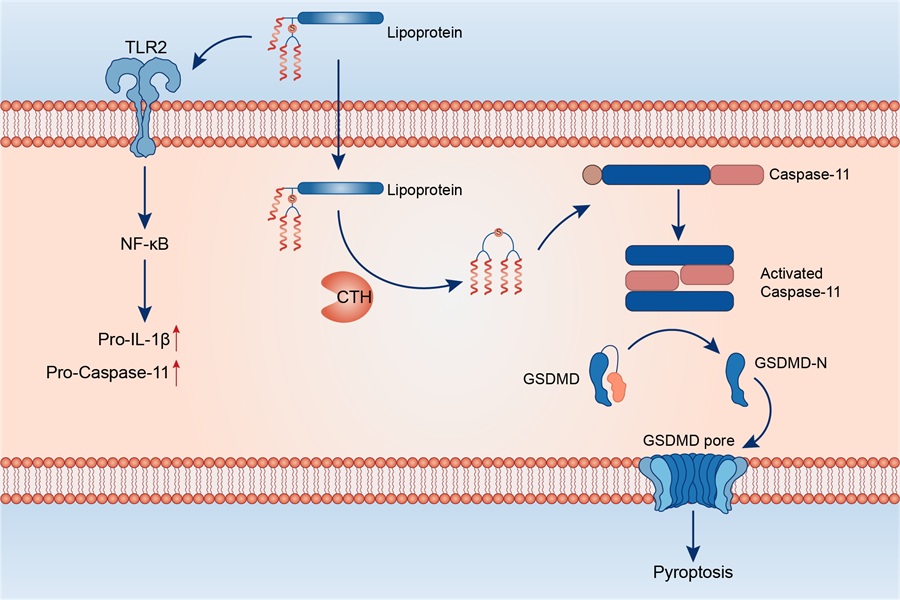
Further in vitro biochemical assays elucidated the molecular mechanism of CTH action: CTH binds to and hydrolyzes bacterial lipoproteins (such as Staphylococcus aureus lipoprotein and the synthetic analogue Pam3CSK4), converting their sulfur containing lipid chains into two acyl chain molecules bearing free sulfhydryl groups. In the oxidative environment of macrophages, two sulfhydryl containing lipid molecules are coupled via a disulfide bond to form a unique tetra acylated molecular structure. This tetra acylated compound can bind to caspase 11 and induce its activation, thereby triggering the noncanonical inflammasome. The team further confirmed, through chemical synthesis, that the disulfide linked tetra acylated lipid molecule indeed possesses the ability to activate caspase 11. Moreover, modulating the redox status of macrophages (promotion by H₂O₂, inhibition by β mercaptoethanol) correspondingly regulated the level of noncanonical inflammasome activation induced by lipoproteins.
Finally, the team generated Cth knockout mice and established infection models with Staphylococcus aureus and Listeria monocytogenes. The results showed that CTH deficient mice exhibited significantly increased susceptibility to these two Gram positive bacteria, as reflected by higher mortality rates, elevated bacterial loads in multiple organs, and decreased serum IL 1β levels. Conversely, AAV mediated CTH overexpression markedly enhanced the anti infective capacity of mice; and treatment with the CTH inhibitor PAG also aggravated infection. These in vivo experiments firmly established the critical physiological role of CTH in immunity against Gram positive bacteria.
This study identifies, for the first time, CTH as a novel intracellular receptor for bacterial lipoproteins, and reveals that in the macrophage cytosol, CTH can bind and hydrolyze bacterial lipoproteins to generate sulfhydryl containing lipid chains, which, under oxidative conditions, form tetra acylated compounds via disulfide bonds to activate caspase 11 mediated noncanonical inflammasome, a previously unrecognized pattern‑recognition mechanism by which the host senses intracellular Gram‑positive bacteria.
Professor Pengyan Xia from the School of Basic Medical Sciences at Peking University and Professor Shuo Wang from the Institute of Microbiology, Chinese Academy of Sciences, are the co corresponding authors of this paper. This work represents another achievement from Xia’s team in the field of innate immunity and anti infectious research. The Xia laboratory focuses on the molecular mechanisms by which innate immune cells resist pathogenic microbial infections, and has systematically identified multiple inflammasome regulatory molecules. Researchers Qiannv Liu, Chunlei Wang, and Mengqian Li are the co first authors of this study. This research was supported by grants from the National Natural Science Foundation of China, among other funding sources.
Article link: https://www.nature.com/articles/s41590-026-02511-9
Bacterial lipoproteins are an important class of pathogen associated molecular patterns. The highly conserved N terminal lipidated cysteine residues anchor them to the bacterial cell membrane. Extracellular recognition of these lipoproteins is well established to be mediated by Toll like receptor 2 (TLR2) on the cell surface. However, whether there are receptors within the cytosol that directly sense bacterial lipoproteins remains a key unsolved question in the field of innate immunity.
Using functional screening and CRISPR/Cas9‑based gene‑knockout approaches, the team identified CTH as an essential mediator of bacterial lipoprotein induced noncanonical inflammasome activation. In CTH‑deficient macrophages, bacterial lipoprotein stimulation failed to trigger caspase‑11 cleavage, GSDMD mediated pyroptosis, or cytokine secretion, whereas the TLR2 downstream NF‑κB pathway was unaffected, suggesting that CTH specifically regulates the noncanonical inflammasome pathway.
Further in vitro biochemical assays elucidated the molecular mechanism of CTH action: CTH binds to and hydrolyzes bacterial lipoproteins (such as Staphylococcus aureus lipoprotein and the synthetic analogue Pam3CSK4), converting their sulfur containing lipid chains into two acyl chain molecules bearing free sulfhydryl groups. In the oxidative environment of macrophages, two sulfhydryl containing lipid molecules are coupled via a disulfide bond to form a unique tetra acylated molecular structure. This tetra acylated compound can bind to caspase 11 and induce its activation, thereby triggering the noncanonical inflammasome. The team further confirmed, through chemical synthesis, that the disulfide linked tetra acylated lipid molecule indeed possesses the ability to activate caspase 11. Moreover, modulating the redox status of macrophages (promotion by H₂O₂, inhibition by β mercaptoethanol) correspondingly regulated the level of noncanonical inflammasome activation induced by lipoproteins.
Finally, the team generated Cth knockout mice and established infection models with Staphylococcus aureus and Listeria monocytogenes. The results showed that CTH deficient mice exhibited significantly increased susceptibility to these two Gram positive bacteria, as reflected by higher mortality rates, elevated bacterial loads in multiple organs, and decreased serum IL 1β levels. Conversely, AAV mediated CTH overexpression markedly enhanced the anti infective capacity of mice; and treatment with the CTH inhibitor PAG also aggravated infection. These in vivo experiments firmly established the critical physiological role of CTH in immunity against Gram positive bacteria.
This study identifies, for the first time, CTH as a novel intracellular receptor for bacterial lipoproteins, and reveals that in the macrophage cytosol, CTH can bind and hydrolyze bacterial lipoproteins to generate sulfhydryl containing lipid chains, which, under oxidative conditions, form tetra acylated compounds via disulfide bonds to activate caspase 11 mediated noncanonical inflammasome, a previously unrecognized pattern‑recognition mechanism by which the host senses intracellular Gram‑positive bacteria.
Professor Pengyan Xia from the School of Basic Medical Sciences at Peking University and Professor Shuo Wang from the Institute of Microbiology, Chinese Academy of Sciences, are the co corresponding authors of this paper. This work represents another achievement from Xia’s team in the field of innate immunity and anti infectious research. The Xia laboratory focuses on the molecular mechanisms by which innate immune cells resist pathogenic microbial infections, and has systematically identified multiple inflammasome regulatory molecules. Researchers Qiannv Liu, Chunlei Wang, and Mengqian Li are the co first authors of this study. This research was supported by grants from the National Natural Science Foundation of China, among other funding sources.
Article link: https://www.nature.com/articles/s41590-026-02511-9
