


Wen Zhou’s Lab Reveals How TREX1 Keeps DNA Sensing in Check
Source:Wen Zhou
2026-06-22
A new study from the laboratory of Dr. Wen Zhou at the Southern University of Science and Technology reveals how TREX1, a key cytosolic DNA exonuclease, recognizes double-stranded DNA and prevents inappropriate activation of the cGAS-STING pathway.
The work, published in the June 9, 2026 issue of Immunity, is titled “Modular double-stranded DNA recognition defines specificity of the exonuclease TREX1 in cGAS-STING control.” The study explains how TREX1 distinguishes double-stranded DNA from other nucleic acid substrates, and how this recognition step helps set the threshold for DNA-induced innate immune activation.
DNA is normally kept inside the nucleus and mitochondria. When DNA appears in the cytosol, it can signal infection, cellular damage, or tumor-associated stress. The DNA sensor cGAS detects cytosolic double-stranded DNA and activates STING-dependent type I interferon responses, a pathway that is important for antiviral defense and anti-tumor immunity.
This protective system also creates a challenge for the cell. Self-DNA can enter the cytosol during genome damage, mitochondrial stress, or abnormal cell division. If this DNA is not properly removed or restrained, cGAS-STING signaling can become chronically active and drive inflammation and autoimmune disease. Cells therefore need mechanisms that preserve immune surveillance while preventing self-DNA from triggering a harmful response.
TREX1 is one of the main enzymes that controls this balance. It removes cytosolic DNA and restrains cGAS-STING activation. Mutations in TREX1 are linked to autoimmune diseases, including Aicardi-Goutières syndrome and systemic lupus erythematosus, and TREX1 activity can also influence tumor immunity.
TREX1 has long been viewed mainly as a DNA-degrading enzyme. However, this view did not fully explain one of its defining features. TREX1 belongs to a broadly conserved DnaQ-like nuclease family whose members generally prefer single-stranded nucleic acid substrates. Yet in human cells, TREX1 has a central role in controlling immune responses driven by double-stranded DNA. How TREX1 acquired this double-stranded DNA specificity, and why this property is important for immune regulation, remained unclear.
The Zhou lab first identified a single residue, R128, as a key determinant of TREX1 double-stranded DNA recognition. When R128 was mutated, TREX1 selectively lost much of its ability to recognize and degrade double-stranded DNA, while its activity toward single-stranded DNA was less affected. The same mutation also impaired the ability of TREX1 to suppress cGAS-STING signaling.
The team then performed the reciprocal experiment. By introducing this residue into the related nuclease TREX2, which normally has poor activity toward double-stranded DNA, they converted TREX2 into an enzyme capable of recognizing and degrading double-stranded DNA. These results demonstrate that TREX1 does not suppress DNA-triggered immunity through catalytic activity alone. Its immune regulatory function depends on the ability to recognize the right DNA substrate.
Using structural biology, biochemistry, and cell-based assays, the study defined a modular mechanism for double-stranded DNA recognition. TREX1 uses several DNA-binding elements that work together. The R128-containing surface senses and stabilizes the non-substrate DNA strand. A conserved substrate-sensing loop helps position the strand that enters the active site. The team also identified a previously unrecognized auxiliary DNA-binding surface, termed the B-site.
The B-site is not required for the basic nuclease activity of TREX1. Instead, it becomes important in cells. When cGAS binds DNA, it can assemble into immune signaling condensates that enrich DNA and amplify pathway activation. To shut down this response, TREX1 must do more than simply cut DNA in solution. It must access DNA that is already engaged by cGAS and competing immune signaling machinery. The B-site helps TREX1 recognize and compete for these DNA substrates, thereby limiting sustained cGAS-STING activation.
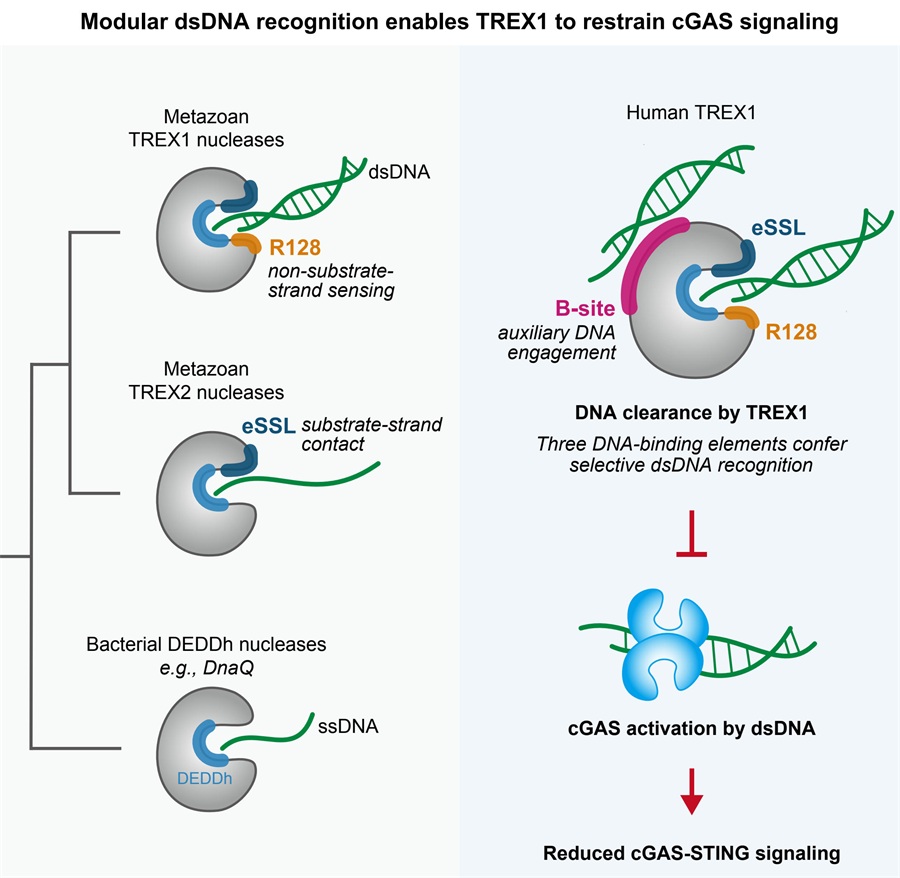
These findings place TREX1 in a broader role than previously appreciated. TREX1 is not only a DNA-clearing enzyme. It is also a substrate recognition factor that helps decide whether cytosolic DNA is cleared or allowed to activate innate immunity.
The study also traced how this function may have evolved. Phylogenetic analysis showed that TREX1 arose from bacterial DnaQ-like nucleases and gradually acquired features such as R128 and additional DNA-binding modules during animal evolution. These changes enabled TREX1 to recognize double-stranded DNA and participate in immune regulation. The work also found that TREX1 and cGAS-like DNA sensing systems tend to co-occur across species, suggesting that DNA sensing and DNA restriction evolved together to maintain immune balance.
The findings provide a new way to think about TREX1-associated disease. TREX1 mutations have often been interpreted as defects in nuclease activity. This study shows that many autoimmune disease- and cancer-associated mutations map to TREX1 surfaces that contact double-stranded DNA. Disease may therefore arise not only when DNA degradation is lost, but also when TREX1 can no longer recognize and control the DNA substrates most relevant to immune activation.
The work also has implications for cancer immunotherapy. In tumor models, disrupting TREX1 DNA recognition increased cGAS-STING activity, enhanced interferon responses, and suppressed tumor growth. This suggests that targeting TREX1-DNA recognition interfaces could provide a way to tune anti-tumor immunity. Such an approach may differ from direct inhibition of TREX1 catalytic activity by more selectively releasing DNA-induced immune signaling while preserving basal DNA metabolism.
Together, the study demonstrates that TREX1 uses a modular double-stranded DNA recognition strategy, built around R128, the substrate-sensing loop, and the B-site, to restrain cGAS-STING signaling. The work connects DNA metabolism, innate immune tolerance, autoimmunity, and tumor immunity through a common mechanism of DNA substrate recognition.
Dr. Wen Zhou, Associate Professor at the Southern University of Science and Technology, is the corresponding author. Ph.D. student Jiali Zhu, Research Assistant Professor Lei Wang, and Ph.D. student Changjie Lin are co-first authors. The study was supported by national and Shenzhen research grants.
Article link: https://doi.org/10.1016/j.immuni.2026.03.025
The work, published in the June 9, 2026 issue of Immunity, is titled “Modular double-stranded DNA recognition defines specificity of the exonuclease TREX1 in cGAS-STING control.” The study explains how TREX1 distinguishes double-stranded DNA from other nucleic acid substrates, and how this recognition step helps set the threshold for DNA-induced innate immune activation.
DNA is normally kept inside the nucleus and mitochondria. When DNA appears in the cytosol, it can signal infection, cellular damage, or tumor-associated stress. The DNA sensor cGAS detects cytosolic double-stranded DNA and activates STING-dependent type I interferon responses, a pathway that is important for antiviral defense and anti-tumor immunity.
This protective system also creates a challenge for the cell. Self-DNA can enter the cytosol during genome damage, mitochondrial stress, or abnormal cell division. If this DNA is not properly removed or restrained, cGAS-STING signaling can become chronically active and drive inflammation and autoimmune disease. Cells therefore need mechanisms that preserve immune surveillance while preventing self-DNA from triggering a harmful response.
TREX1 is one of the main enzymes that controls this balance. It removes cytosolic DNA and restrains cGAS-STING activation. Mutations in TREX1 are linked to autoimmune diseases, including Aicardi-Goutières syndrome and systemic lupus erythematosus, and TREX1 activity can also influence tumor immunity.
TREX1 has long been viewed mainly as a DNA-degrading enzyme. However, this view did not fully explain one of its defining features. TREX1 belongs to a broadly conserved DnaQ-like nuclease family whose members generally prefer single-stranded nucleic acid substrates. Yet in human cells, TREX1 has a central role in controlling immune responses driven by double-stranded DNA. How TREX1 acquired this double-stranded DNA specificity, and why this property is important for immune regulation, remained unclear.
The Zhou lab first identified a single residue, R128, as a key determinant of TREX1 double-stranded DNA recognition. When R128 was mutated, TREX1 selectively lost much of its ability to recognize and degrade double-stranded DNA, while its activity toward single-stranded DNA was less affected. The same mutation also impaired the ability of TREX1 to suppress cGAS-STING signaling.
The team then performed the reciprocal experiment. By introducing this residue into the related nuclease TREX2, which normally has poor activity toward double-stranded DNA, they converted TREX2 into an enzyme capable of recognizing and degrading double-stranded DNA. These results demonstrate that TREX1 does not suppress DNA-triggered immunity through catalytic activity alone. Its immune regulatory function depends on the ability to recognize the right DNA substrate.
Using structural biology, biochemistry, and cell-based assays, the study defined a modular mechanism for double-stranded DNA recognition. TREX1 uses several DNA-binding elements that work together. The R128-containing surface senses and stabilizes the non-substrate DNA strand. A conserved substrate-sensing loop helps position the strand that enters the active site. The team also identified a previously unrecognized auxiliary DNA-binding surface, termed the B-site.
The B-site is not required for the basic nuclease activity of TREX1. Instead, it becomes important in cells. When cGAS binds DNA, it can assemble into immune signaling condensates that enrich DNA and amplify pathway activation. To shut down this response, TREX1 must do more than simply cut DNA in solution. It must access DNA that is already engaged by cGAS and competing immune signaling machinery. The B-site helps TREX1 recognize and compete for these DNA substrates, thereby limiting sustained cGAS-STING activation.
These findings place TREX1 in a broader role than previously appreciated. TREX1 is not only a DNA-clearing enzyme. It is also a substrate recognition factor that helps decide whether cytosolic DNA is cleared or allowed to activate innate immunity.
The study also traced how this function may have evolved. Phylogenetic analysis showed that TREX1 arose from bacterial DnaQ-like nucleases and gradually acquired features such as R128 and additional DNA-binding modules during animal evolution. These changes enabled TREX1 to recognize double-stranded DNA and participate in immune regulation. The work also found that TREX1 and cGAS-like DNA sensing systems tend to co-occur across species, suggesting that DNA sensing and DNA restriction evolved together to maintain immune balance.
The findings provide a new way to think about TREX1-associated disease. TREX1 mutations have often been interpreted as defects in nuclease activity. This study shows that many autoimmune disease- and cancer-associated mutations map to TREX1 surfaces that contact double-stranded DNA. Disease may therefore arise not only when DNA degradation is lost, but also when TREX1 can no longer recognize and control the DNA substrates most relevant to immune activation.
The work also has implications for cancer immunotherapy. In tumor models, disrupting TREX1 DNA recognition increased cGAS-STING activity, enhanced interferon responses, and suppressed tumor growth. This suggests that targeting TREX1-DNA recognition interfaces could provide a way to tune anti-tumor immunity. Such an approach may differ from direct inhibition of TREX1 catalytic activity by more selectively releasing DNA-induced immune signaling while preserving basal DNA metabolism.
Together, the study demonstrates that TREX1 uses a modular double-stranded DNA recognition strategy, built around R128, the substrate-sensing loop, and the B-site, to restrain cGAS-STING signaling. The work connects DNA metabolism, innate immune tolerance, autoimmunity, and tumor immunity through a common mechanism of DNA substrate recognition.
Dr. Wen Zhou, Associate Professor at the Southern University of Science and Technology, is the corresponding author. Ph.D. student Jiali Zhu, Research Assistant Professor Lei Wang, and Ph.D. student Changjie Lin are co-first authors. The study was supported by national and Shenzhen research grants.
Article link: https://doi.org/10.1016/j.immuni.2026.03.025
