

Guangchuan Wang, Zhengxin Wang, and Chenqi Xu Teams Identify SOAT1-Mediated Cholesterol Esterification as a Driver of Liver Cancer Immune Escape and Recurrence
Source:Guangchuan Wang
2026-07-20
On July 3, 2026, the research teams of Guangchuan Wang and Chenqi Xu from the Center for Excellence in Molecular Cell Science (Shanghai Institute of Biochemistry and Cell Biology) of the Chinese Academy of Sciences, in collaboration with the team of Zhengxin Wang from Huashan Hospital, Fudan University, published an online research article in the journal Immunity entitled "Targeting cholesterol esterification sensitizes liver cancer to CD8+ T cell attack by impairing metabolic and redox resilience." This study reveals that the cholesterol esterification enzyme SOAT1 assists tumors in resisting CD8+ T cell immune attack by maintaining the metabolic and redox resilience of tumor cells; targeting SOAT1 can significantly enhance the efficacy of anti-PD-1 therapy and CAR-T cell therapy, providing a novel metabolic intervention strategy for the prevention of liver cancer recurrence and the sensitization of immunotherapy.
Postoperative recurrence of hepatocellular carcinoma (HCC) represents a major challenge in clinical management. The recurrence rate after liver transplantation can reach 40%, and the 5-year recurrence rate after liver resection is as high as 70%. In recent years, immunotherapies represented by immune checkpoint inhibitors (ICIs) have revolutionized cancer treatment paradigms, yet their overall efficacy in HCC remains limited. Accumulating evidence indicates that tumor cells frequently evade immune surveillance and resist therapy through metabolic reprogramming, a problem particularly pronounced in HCC—metabolic disorders such as obesity and hypercholesterolemia are important drivers of HCC progression and recurrence. However, a systematic understanding of which metabolic pathways drive immune evasion and postoperative recurrence in HCC has been lacking.
To address this challenge, the research team collected tumor samples from 28 HCC patients who had undergone liver transplantation, stratified them into recurrence and non-recurrence groups based on 5-year follow-up results, and conducted proteomic analysis to identify differentially expressed proteins closely associated with recurrence. Further combined with T cell co-culture killing screens, the team ultimately pinpointed the cholesterol esterification enzyme SOAT1 as a key metabolic factor driving immune evasion and recurrence in HCC. SOAT1 is an endoplasmic reticulum-localized cholesterol esterification enzyme responsible for converting free cholesterol into cholesteryl esters for storage. Clinical analyses revealed that patients with high SOAT1 expression exhibited higher recurrence rates and poorer overall survival; among HCC patients receiving immunotherapy, those with high SOAT1 expression showed poorer responses to ICI therapy. Multiplex immunofluorescence further demonstrated that SOAT1 expression was positively correlated with cholesterol metabolism and CD11b+ myeloid cell infiltration.
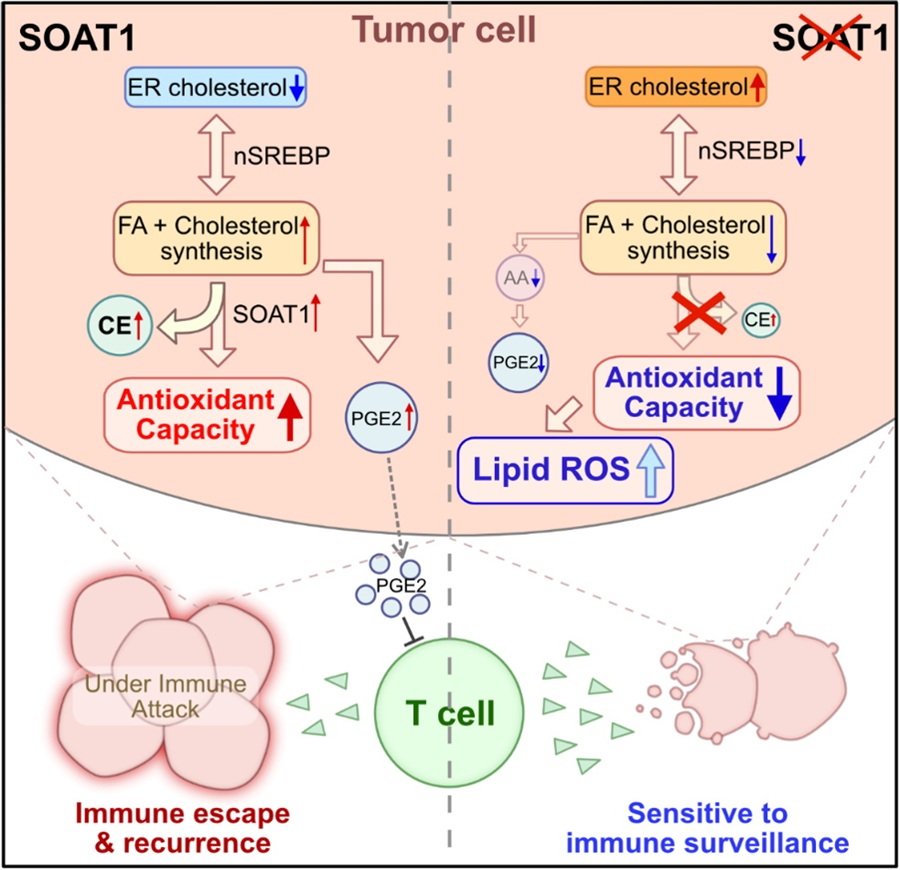
Further mechanistic investigations elucidated the molecular basis of SOAT1-mediated immune evasion. Genetic knockout or pharmacological inhibition of SOAT1 leads to accumulation of free cholesterol in the endoplasmic reticulum of tumor cells, which in turn suppresses SREBP1/2 processing and nuclear translocation through the SCAP-mediated retention mechanism, thereby inhibiting cholesterol and fatty acid biosynthesis. This metabolic reprogramming exerts two important effects: on one hand, reduced synthesis of unsaturated fatty acids and glycerophospholipids leads to decreased production of the immunosuppressive factor prostaglandin E2 (PGE2), thereby alleviating tumor-mediated immunosuppression of CD8+ T cells; on the other hand, depletion of cholesterol-derived antioxidant metabolic intermediates renders tumor cells unable to maintain redox homeostasis under immune attack such as IFN-γ, resulting in substantial accumulation of lipid reactive oxygen species (lipid ROS) and ultimately increasing the susceptibility of tumor cells to CD8+ T cell killing. In brief, SOAT1-mediated cholesterol esterification is not merely a lipid storage process, but also a critical mechanism by which tumors maintain "metabolic and redox resilience" to withstand immune attack.
The research team further validated the therapeutic potential of targeting SOAT1 in multiple preclinical models. In immunocompetent mice, both knockout of tumor cell Soat1 and treatment with the SOAT1 inhibitor avasimibe significantly enhanced tumor susceptibility to CD8+ T cell immune surveillance and markedly improved the efficacy of anti-PD-1 antibody therapy. In human HCC xenograft models, SOAT1 deficiency similarly significantly enhanced the killing efficacy of GPC3-specific CAR-T cells. Single-cell transcriptomic sequencing further revealed that SOAT1 deficiency remodels the tumor immune microenvironment and promotes CD8+ T cell infiltration.
Importantly, this strategy demonstrated promising application potential in two clinically challenging scenarios. In an obesity-associated HCC model, SOAT1 inhibition combined with anti-PD-1 antibody therapy achieved significant therapeutic efficacy; in a mouse model mimicking the immunosuppressive state after liver transplantation, SOAT1 inhibition similarly effectively suppressed tumor progression. The research team further constructed tacrolimus-resistant CAR-T cells (TR-CAR) and confirmed that SOAT1 deficiency significantly enhances the antitumor efficacy of CAR-T cells even under immunosuppressive conditions.
In summary, this study, proceeding from clinical samples and integrating proteomic analysis, functional screening, and mechanistic investigation, identifies SOAT1 as a key metabolic target for immune evasion and postoperative recurrence in HCC. For the first time, the study establishes a signaling axis of "cholesterol esterification—metabolic and redox resilience—immune evasion," revealing the critical mechanism by which cholesterol esterification facilitates tumor evasion of CD8+ T cell attack, and providing a new theoretical basis for understanding the crosstalk between tumor metabolism and immune regulation. Targeting SOAT1 holds promise as an effective strategy to overcome immunotherapy resistance and reduce postoperative recurrence risk in HCC, with particular translational potential for obesity-associated HCC and post-liver transplantation patients.
Yange Gu (joint Ph.D. student of Huashan Hospital and the Center for Excellence in Molecular Cell Science), Lulu Zhang (research technician at the Center for Excellence in Molecular Cell Science), Dr. Jianhua Li, and Dr. Ensi Ma from Huashan Hospital are the co-first authors of this article. Prof. Guangchuan Wang (Center for Excellence in Molecular Cell Science), Prof. Zhengxin Wang (Huashan Hospital, Fudan University), and Prof. Chenqi Xu (Center for Excellence in Molecular Cell Science) are the co-corresponding authors.
This study is supported by the National Key Research and Development Program of China, the Strategic Priority Research Program of the Chinese Academy of Sciences, National Natural Science Foundation of China, Shanghai Original Exploratory Program. This work received substantial support from the Chemical Biology Core Facility, the Cell Analysis Core Facility, the Molecular Biology Core Facility, and the Animal Core Facility of the Center for Excellence in Molecular Cell Science.
Article link: https://www.cell.com/immunity/abstract/S1074-7613(26)00253-0
Postoperative recurrence of hepatocellular carcinoma (HCC) represents a major challenge in clinical management. The recurrence rate after liver transplantation can reach 40%, and the 5-year recurrence rate after liver resection is as high as 70%. In recent years, immunotherapies represented by immune checkpoint inhibitors (ICIs) have revolutionized cancer treatment paradigms, yet their overall efficacy in HCC remains limited. Accumulating evidence indicates that tumor cells frequently evade immune surveillance and resist therapy through metabolic reprogramming, a problem particularly pronounced in HCC—metabolic disorders such as obesity and hypercholesterolemia are important drivers of HCC progression and recurrence. However, a systematic understanding of which metabolic pathways drive immune evasion and postoperative recurrence in HCC has been lacking.
To address this challenge, the research team collected tumor samples from 28 HCC patients who had undergone liver transplantation, stratified them into recurrence and non-recurrence groups based on 5-year follow-up results, and conducted proteomic analysis to identify differentially expressed proteins closely associated with recurrence. Further combined with T cell co-culture killing screens, the team ultimately pinpointed the cholesterol esterification enzyme SOAT1 as a key metabolic factor driving immune evasion and recurrence in HCC. SOAT1 is an endoplasmic reticulum-localized cholesterol esterification enzyme responsible for converting free cholesterol into cholesteryl esters for storage. Clinical analyses revealed that patients with high SOAT1 expression exhibited higher recurrence rates and poorer overall survival; among HCC patients receiving immunotherapy, those with high SOAT1 expression showed poorer responses to ICI therapy. Multiplex immunofluorescence further demonstrated that SOAT1 expression was positively correlated with cholesterol metabolism and CD11b+ myeloid cell infiltration.
Further mechanistic investigations elucidated the molecular basis of SOAT1-mediated immune evasion. Genetic knockout or pharmacological inhibition of SOAT1 leads to accumulation of free cholesterol in the endoplasmic reticulum of tumor cells, which in turn suppresses SREBP1/2 processing and nuclear translocation through the SCAP-mediated retention mechanism, thereby inhibiting cholesterol and fatty acid biosynthesis. This metabolic reprogramming exerts two important effects: on one hand, reduced synthesis of unsaturated fatty acids and glycerophospholipids leads to decreased production of the immunosuppressive factor prostaglandin E2 (PGE2), thereby alleviating tumor-mediated immunosuppression of CD8+ T cells; on the other hand, depletion of cholesterol-derived antioxidant metabolic intermediates renders tumor cells unable to maintain redox homeostasis under immune attack such as IFN-γ, resulting in substantial accumulation of lipid reactive oxygen species (lipid ROS) and ultimately increasing the susceptibility of tumor cells to CD8+ T cell killing. In brief, SOAT1-mediated cholesterol esterification is not merely a lipid storage process, but also a critical mechanism by which tumors maintain "metabolic and redox resilience" to withstand immune attack.
The research team further validated the therapeutic potential of targeting SOAT1 in multiple preclinical models. In immunocompetent mice, both knockout of tumor cell Soat1 and treatment with the SOAT1 inhibitor avasimibe significantly enhanced tumor susceptibility to CD8+ T cell immune surveillance and markedly improved the efficacy of anti-PD-1 antibody therapy. In human HCC xenograft models, SOAT1 deficiency similarly significantly enhanced the killing efficacy of GPC3-specific CAR-T cells. Single-cell transcriptomic sequencing further revealed that SOAT1 deficiency remodels the tumor immune microenvironment and promotes CD8+ T cell infiltration.
Importantly, this strategy demonstrated promising application potential in two clinically challenging scenarios. In an obesity-associated HCC model, SOAT1 inhibition combined with anti-PD-1 antibody therapy achieved significant therapeutic efficacy; in a mouse model mimicking the immunosuppressive state after liver transplantation, SOAT1 inhibition similarly effectively suppressed tumor progression. The research team further constructed tacrolimus-resistant CAR-T cells (TR-CAR) and confirmed that SOAT1 deficiency significantly enhances the antitumor efficacy of CAR-T cells even under immunosuppressive conditions.
In summary, this study, proceeding from clinical samples and integrating proteomic analysis, functional screening, and mechanistic investigation, identifies SOAT1 as a key metabolic target for immune evasion and postoperative recurrence in HCC. For the first time, the study establishes a signaling axis of "cholesterol esterification—metabolic and redox resilience—immune evasion," revealing the critical mechanism by which cholesterol esterification facilitates tumor evasion of CD8+ T cell attack, and providing a new theoretical basis for understanding the crosstalk between tumor metabolism and immune regulation. Targeting SOAT1 holds promise as an effective strategy to overcome immunotherapy resistance and reduce postoperative recurrence risk in HCC, with particular translational potential for obesity-associated HCC and post-liver transplantation patients.
Yange Gu (joint Ph.D. student of Huashan Hospital and the Center for Excellence in Molecular Cell Science), Lulu Zhang (research technician at the Center for Excellence in Molecular Cell Science), Dr. Jianhua Li, and Dr. Ensi Ma from Huashan Hospital are the co-first authors of this article. Prof. Guangchuan Wang (Center for Excellence in Molecular Cell Science), Prof. Zhengxin Wang (Huashan Hospital, Fudan University), and Prof. Chenqi Xu (Center for Excellence in Molecular Cell Science) are the co-corresponding authors.
This study is supported by the National Key Research and Development Program of China, the Strategic Priority Research Program of the Chinese Academy of Sciences, National Natural Science Foundation of China, Shanghai Original Exploratory Program. This work received substantial support from the Chemical Biology Core Facility, the Cell Analysis Core Facility, the Molecular Biology Core Facility, and the Animal Core Facility of the Center for Excellence in Molecular Cell Science.
Article link: https://www.cell.com/immunity/abstract/S1074-7613(26)00253-0
