

Cover Story by Rong-Rong He, Yi-Fang Li and Shu-Hua Ouyang’s Team Reveals the Essential role of ALOX15 in Mitochondrial Antiviral Immunity and Develops a Synergistic ALOX15 Regulation Strategy Against Influenza
Source:Rong-Rong He
2026-09-08
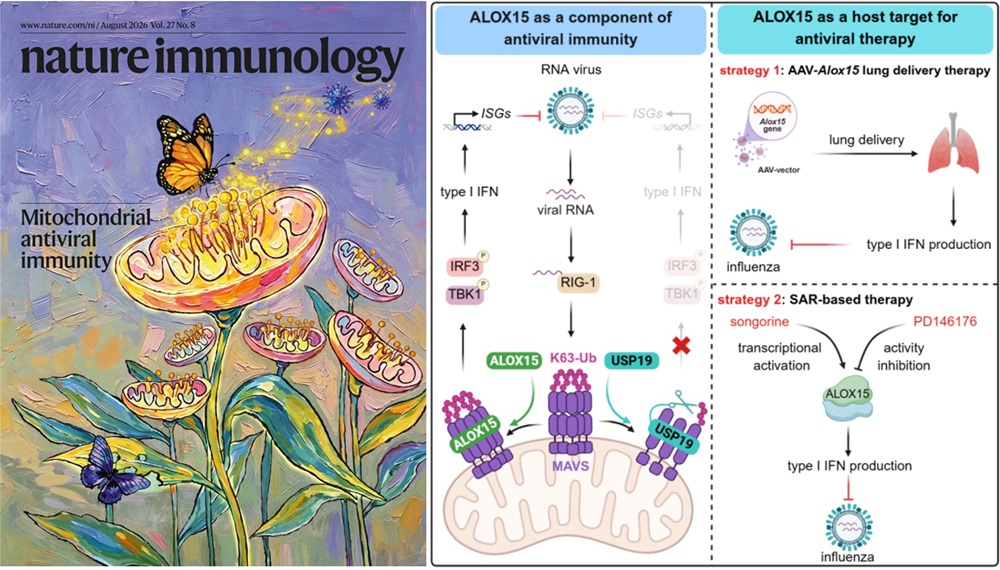
On July 8, 2026, Prof. Rong-Rong He, Prof. Yi-Fang Li and Dr. Shu-Hua Ouyang at Jinan University published a research article in Nature Immunology as a cover story, entitled “ALOX15 orchestrates mitochondrial antiviral immunity and serves as a host target for anti-influenza therapy.” It was selected as the cover article for Volume 27, Issue 8, published in August 2026, under the cover theme “Mitochondrial antivirus signaling.” The cover, rendered in a hand-painted oil-painting style, vividly depicts the scientific discovery: “Butterfly (ALOX15) Blossoms the Flower (MAVS)”, a metaphor for ALOX15 transforming to protect mitochondrial antiviral immunity. In the illustration, the stress-response protein ALOX15, a lipoxygenase, can generate oxidative stress products under specific conditions, triggering oxidative damage to cellular lipids. This is represented by the purple-blue butterfly nibbling on leaves. When cells are attacked by viruses, ALOX15 transforms into a golden butterfly that firmly promotes the aggregation of the mitochondrial antiviral protein MAVS. This in turn drives sustained type I IFN production and effectively protects against viral infection. This artistic representation conveys the central scientific significance of ALOX15 as a novel regulator and target of mitochondrial antiviral immunity. It also delivers a Synergistic ALOX15 Regulation strategy against influenza: On the one hand, suppressing the lipid peroxidation damage mediated by ALOX15 in its “purple-blue butterfly” state; and on the other, promoting its transformation into the “golden butterfly” state to enhance antiviral immune responses.
Viral infection triggers cellular stress responses, and host stress proteins play critical roles in antiviral defense. Previous work by the research team revealed that cellular stress responses driven by various emotional and environmental factors can profoundly influence antiviral immunity. In the present study, the researchers found that deficiency of the stress-response protein ALOX15 increases susceptibility to influenza viruses, SARS-CoV-2 and other respiratory RNA viruses. The study identified ALOX15 as a previously unknown key positive regulator in the mitochondrial antiviral immune signaling pathway, namely the RIG-I/MAVS antiviral signaling pathway. During infection with RNA viruses, including influenza viruses H1N1 and H3N2 and human coronavirus 229E, ALOX15 is recruited by polymerized MAVS and translocates from the cytoplasm to the outer mitochondrial membrane. Through its stronger affinity, ALOX15 displaces the deubiquitinase USP19, thereby protecting the K63-linked ubiquitination of MAVS and stabilizing its oligomerization activity. This efficiently activates the downstream TBK1–IRF3 pathway and promotes the production of type I IFN. Most importantly, this novel role of ALOX15 in antiviral innate immunity is independent of its lipoxygenase enzymatic activity. These findings provide a new perspective on how the host overcomes the slow response associated with transcriptional regulation and initiates a rapid response through protein translocation to combat viral infection.
Previous understanding of the immunological and inflammatory functions of ALOX15 has focused almost entirely on its ability to induce or resolve inflammation through the catalytic production of lipid mediators, a classical paradigm established in textbooks. This study challenges that conventional view by demonstrating that ALOX15 can directly translocate to mitochondria and regulate the assembly of immune signaling complexes in a manner completely independent of its canonical enzymatic activity. The discovery expands the functional classification of ALOX15 from a “metabolic enzyme” to a “signaling regulatory molecule,” adding a new dimension to its functional profile in immunology. Furthermore, the study directly links ALOX15, as a key regulator of ferroptosis, with the innate antiviral immune signaling pathway. Under the specific stress conditions of viral infection, the enzymatic function of ALOX15, which promotes lipid peroxidation, and its nonenzymatic function, which promotes immunity, can be functionally separated and used synergistically. This finding suggests that phospholipid oxidative metabolism may exert different, or even completely opposite, effects under different physiological and pathological conditions and in different disease states.
Traditional Chinese medicine has a long history and unique advantages in immune regulation and the treatment of infectious diseases. However, the scientific basis of traditional Chinese medicine remains to be further elucidated and expanded. In this study, the researchers screened a range of clinically effective traditional Chinese medicinal formulas and remedies for respiratory infections. They identified the natural diterpenoid alkaloid songorine, derived primarily from the traditional Chinese medicinal herb Fuzi (Aconitum carmichaelii), as a potent transcriptional activator of ALOX15. Songorine specifically increases ALOX15 expression and thereby enhances MAVS-mediated antiviral immunity. Based on the dual features of ALOX15, capable of activating beneficial antiviral immunity through its nonenzymatic function while potentially inducing harmful lipid peroxidation through its enzymatic activity, the research team proposed a novel antiviral strategy known as Synergistic ALOX15 Regulation (SAR). This strategy combines an ALOX15 transcriptional activator with an inhibitor of its enzymatic activity. By targeting two distinct functional aspects of the same protein, the “one target, dual modulation” approach achieves synergistic effects, maximizing the antiviral interferon response while effectively avoiding the risk of ALOX15-mediated ferroptotic toxicity.
In summary, this study identifies ALOX15 as a key positive host factor regulating mitochondrial antiviral immune signaling and as a novel target for anti-influenza therapy. Through a new mechanism involving the nonenzymatic function of ALOX15 and its mitochondrial translocation-mediated competitive displacement of a deubiquitinase, ALOX15 finely regulates the activation threshold of MAVS. The findings provide new insights into the synergistic, multi-component mechanisms underlying the anti-influenza effects of traditional Chinese medicines. They also open a new direction for the development of broad-spectrum therapeutics against highly mutagenic RNA viruses, including influenza viruses and SARS-CoV-2.
Jing-Yu Weng and Xin-Xing Chen, two Ph.D candidates from the College of Pharmacy in Jinan University, are co-first authors of the article.
Article link: https://www.nature.com/articles/s41590-026-02584-6
Viral infection triggers cellular stress responses, and host stress proteins play critical roles in antiviral defense. Previous work by the research team revealed that cellular stress responses driven by various emotional and environmental factors can profoundly influence antiviral immunity. In the present study, the researchers found that deficiency of the stress-response protein ALOX15 increases susceptibility to influenza viruses, SARS-CoV-2 and other respiratory RNA viruses. The study identified ALOX15 as a previously unknown key positive regulator in the mitochondrial antiviral immune signaling pathway, namely the RIG-I/MAVS antiviral signaling pathway. During infection with RNA viruses, including influenza viruses H1N1 and H3N2 and human coronavirus 229E, ALOX15 is recruited by polymerized MAVS and translocates from the cytoplasm to the outer mitochondrial membrane. Through its stronger affinity, ALOX15 displaces the deubiquitinase USP19, thereby protecting the K63-linked ubiquitination of MAVS and stabilizing its oligomerization activity. This efficiently activates the downstream TBK1–IRF3 pathway and promotes the production of type I IFN. Most importantly, this novel role of ALOX15 in antiviral innate immunity is independent of its lipoxygenase enzymatic activity. These findings provide a new perspective on how the host overcomes the slow response associated with transcriptional regulation and initiates a rapid response through protein translocation to combat viral infection.
Cover Story: Butterfly (ALOX15) Blossoms the Flower (MAVS)
Previous understanding of the immunological and inflammatory functions of ALOX15 has focused almost entirely on its ability to induce or resolve inflammation through the catalytic production of lipid mediators, a classical paradigm established in textbooks. This study challenges that conventional view by demonstrating that ALOX15 can directly translocate to mitochondria and regulate the assembly of immune signaling complexes in a manner completely independent of its canonical enzymatic activity. The discovery expands the functional classification of ALOX15 from a “metabolic enzyme” to a “signaling regulatory molecule,” adding a new dimension to its functional profile in immunology. Furthermore, the study directly links ALOX15, as a key regulator of ferroptosis, with the innate antiviral immune signaling pathway. Under the specific stress conditions of viral infection, the enzymatic function of ALOX15, which promotes lipid peroxidation, and its nonenzymatic function, which promotes immunity, can be functionally separated and used synergistically. This finding suggests that phospholipid oxidative metabolism may exert different, or even completely opposite, effects under different physiological and pathological conditions and in different disease states.
Traditional Chinese medicine has a long history and unique advantages in immune regulation and the treatment of infectious diseases. However, the scientific basis of traditional Chinese medicine remains to be further elucidated and expanded. In this study, the researchers screened a range of clinically effective traditional Chinese medicinal formulas and remedies for respiratory infections. They identified the natural diterpenoid alkaloid songorine, derived primarily from the traditional Chinese medicinal herb Fuzi (Aconitum carmichaelii), as a potent transcriptional activator of ALOX15. Songorine specifically increases ALOX15 expression and thereby enhances MAVS-mediated antiviral immunity. Based on the dual features of ALOX15, capable of activating beneficial antiviral immunity through its nonenzymatic function while potentially inducing harmful lipid peroxidation through its enzymatic activity, the research team proposed a novel antiviral strategy known as Synergistic ALOX15 Regulation (SAR). This strategy combines an ALOX15 transcriptional activator with an inhibitor of its enzymatic activity. By targeting two distinct functional aspects of the same protein, the “one target, dual modulation” approach achieves synergistic effects, maximizing the antiviral interferon response while effectively avoiding the risk of ALOX15-mediated ferroptotic toxicity.
In summary, this study identifies ALOX15 as a key positive host factor regulating mitochondrial antiviral immune signaling and as a novel target for anti-influenza therapy. Through a new mechanism involving the nonenzymatic function of ALOX15 and its mitochondrial translocation-mediated competitive displacement of a deubiquitinase, ALOX15 finely regulates the activation threshold of MAVS. The findings provide new insights into the synergistic, multi-component mechanisms underlying the anti-influenza effects of traditional Chinese medicines. They also open a new direction for the development of broad-spectrum therapeutics against highly mutagenic RNA viruses, including influenza viruses and SARS-CoV-2.
Jing-Yu Weng and Xin-Xing Chen, two Ph.D candidates from the College of Pharmacy in Jinan University, are co-first authors of the article.
Article link: https://www.nature.com/articles/s41590-026-02584-6
