


Tsinghua University and Zhejiang University Teams Reveal that Metastasis Enhances Immunogenicity through Migrasome-Mediated Antigen Release
Source:Dong Jiang
2026-10-23
A collaborative study led by Professor Li Yu at Tsinghua University and Professor Dong Jiang at Zhejiang University has been published in Nature Immunology under the title “Metastasis enables immunogenicity through migrasome-mediated antigen release.” The study reveals for the first time that circulating tumor cells (CTCs) undergoing vascular migration produce migrasomes, which are enriched in tumor-associated antigens. These migrasomes are efficiently captured by antigen-presenting cells and cross-presented to activate CD8+ T cell-mediated anti-metastatic immune responses. Professor Li Yu and Professor Dong Jiang are co-corresponding authors, and Dr. Dong Jiang and Dr. Jinzhao He are co-first authors. The work was supported by the National Natural Science Foundation of China, the National Key R&D Program of China, and the New Cornerstone Science Foundation.
Tumor metastasis has long been regarded as a major route of immune escape. Antigen release is essential for initiating anti-tumor immunity, but whether antigen release is specifically regulated during active tumor metastasis remained unclear. Migrasomes are a newly identified organelle discovered, named, and first reported by Professor Li Yu’s team in 2014. Over the past decade, the team has systematically dissected the biogenesis and physiological/pathological functions of migrasomes. Whether migrasomes participate in tumor antigen release and presentation had not been reported previously.
Using a 4T1 mouse breast cancer model, the study found that Tspan4 deficiency significantly enhanced lung metastasis, whereas Tspan4 overexpression markedly suppressed metastasis and prolonged survival, without affecting primary subcutaneous tumor growth. In the MMTV-PyMT spontaneous metastasis model, Tspan4 knockout also increased lung metastasis. Injection of purified migrasomes into mice significantly reversed the enhanced metastasis phenotype of Tspan4-knockout cells and prolonged survival. In equal-protein comparisons, migrasomes, but not small extracellular vesicles, apoptotic bodies, or tumor lysates, significantly inhibited metastasis and prolonged survival, indicating that migrasomes are not a conventional extracellular vesicle subset but a distinct antigen-delivery vehicle with unique immunostimulatory activity.
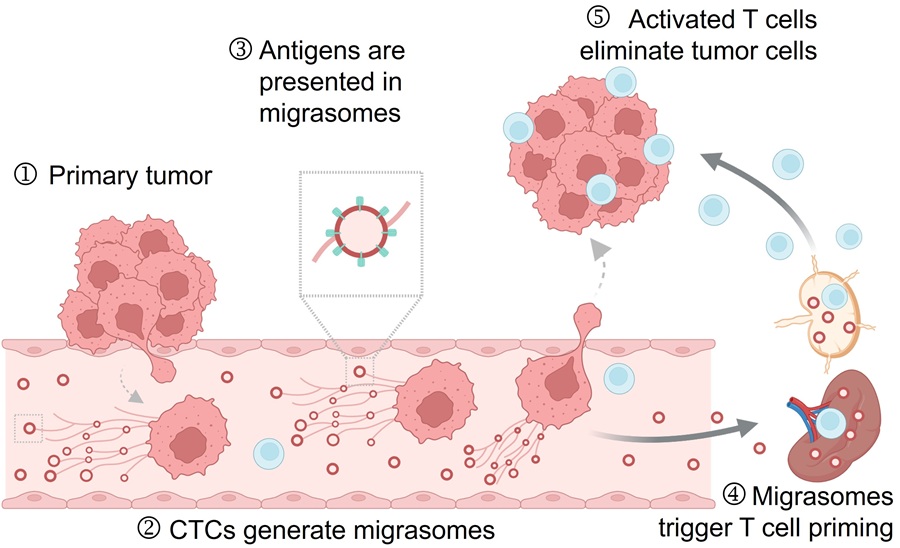
Mechanistically, migrasomes entering secondary lymphoid organs were efficiently captured by antigen-presenting cells. The anti-metastatic effect of migrasomes was lost in B2m-knockout bone marrow chimeric mice, demonstrating a requirement for MHC-I-dependent cross-presentation. The effect was significantly attenuated in Batf3-knockout mice and further reduced after macrophage depletion, suggesting that dendritic cells and macrophages jointly contribute to migrasome-induced anti-tumor immunity. In vitro killing assays showed that CD8+ T cells from migrasome-immunized mice could attack and kill 4T1 cells. Proteomic and genomic analyses further identified enriched antigens in 4T1-derived migrasomes, including mutant antigens DDHD1(D318H) and SDC2(A18S) and the cancer-testis antigen BRDT. These phenotypes were abolished in T cell-deficient nude mice, indicating T cell-dependent immune surveillance.
This study challenges the conventional view that metastasis inevitably means immune escape and proposes that the metastatic process itself can be exploited by the immune system. From a translational perspective, migrasomes are established as an endogenous tumor antigen delivery platform, offering a new strategy for tumor vaccine design and immunotherapy: using migrasomes as a “natural adjuvant” to efficiently deliver tumor antigens to antigen-presenting cells and activate specific anti-tumor immunity. The unique composition and immunostimulatory properties of migrasomes may make them a promising target for improving cancer immunotherapy. Notably, migrasome research is a field pioneered and continuously led by Chinese scientists, and this work marks a key transition of migrasome research from a cell biological phenomenon toward a tumor immunotherapy tool.
Article link: https://www.nature.com/articles/s41590-026-02641-0
Tumor metastasis has long been regarded as a major route of immune escape. Antigen release is essential for initiating anti-tumor immunity, but whether antigen release is specifically regulated during active tumor metastasis remained unclear. Migrasomes are a newly identified organelle discovered, named, and first reported by Professor Li Yu’s team in 2014. Over the past decade, the team has systematically dissected the biogenesis and physiological/pathological functions of migrasomes. Whether migrasomes participate in tumor antigen release and presentation had not been reported previously.
Using a 4T1 mouse breast cancer model, the study found that Tspan4 deficiency significantly enhanced lung metastasis, whereas Tspan4 overexpression markedly suppressed metastasis and prolonged survival, without affecting primary subcutaneous tumor growth. In the MMTV-PyMT spontaneous metastasis model, Tspan4 knockout also increased lung metastasis. Injection of purified migrasomes into mice significantly reversed the enhanced metastasis phenotype of Tspan4-knockout cells and prolonged survival. In equal-protein comparisons, migrasomes, but not small extracellular vesicles, apoptotic bodies, or tumor lysates, significantly inhibited metastasis and prolonged survival, indicating that migrasomes are not a conventional extracellular vesicle subset but a distinct antigen-delivery vehicle with unique immunostimulatory activity.
Mechanistically, migrasomes entering secondary lymphoid organs were efficiently captured by antigen-presenting cells. The anti-metastatic effect of migrasomes was lost in B2m-knockout bone marrow chimeric mice, demonstrating a requirement for MHC-I-dependent cross-presentation. The effect was significantly attenuated in Batf3-knockout mice and further reduced after macrophage depletion, suggesting that dendritic cells and macrophages jointly contribute to migrasome-induced anti-tumor immunity. In vitro killing assays showed that CD8+ T cells from migrasome-immunized mice could attack and kill 4T1 cells. Proteomic and genomic analyses further identified enriched antigens in 4T1-derived migrasomes, including mutant antigens DDHD1(D318H) and SDC2(A18S) and the cancer-testis antigen BRDT. These phenotypes were abolished in T cell-deficient nude mice, indicating T cell-dependent immune surveillance.
This study challenges the conventional view that metastasis inevitably means immune escape and proposes that the metastatic process itself can be exploited by the immune system. From a translational perspective, migrasomes are established as an endogenous tumor antigen delivery platform, offering a new strategy for tumor vaccine design and immunotherapy: using migrasomes as a “natural adjuvant” to efficiently deliver tumor antigens to antigen-presenting cells and activate specific anti-tumor immunity. The unique composition and immunostimulatory properties of migrasomes may make them a promising target for improving cancer immunotherapy. Notably, migrasome research is a field pioneered and continuously led by Chinese scientists, and this work marks a key transition of migrasome research from a cell biological phenomenon toward a tumor immunotherapy tool.
Article link: https://www.nature.com/articles/s41590-026-02641-0
