


Menghua Xiong's Team Discovers Use of Synthetic Materials to Trigger Immunogenic Membrane-lytic Cell Death, Providing a New Strategy for Immunotherapy
Source:Menghua Xiong
2026-11-02
Published in the 1 October 2026 issue of Nature (published online on 5 August 2026), a research article titled "Membranolytic peptide programs immunogenic cell death for cancer therapy" was reported by Professor Menghua Xiong of South China University of Technology and colleagues. Dr. Yueling Yuan, Dr. Lifang Liang, and Dr. Jie Li are co-first authors, and Professor Menghua Xiong, Professor Yan Bao, Professor Jianjun Cheng, and Professor Shiyan Xiao are co-corresponding authors. The study also received support from the teams of Professor Zhexiong Lian at Guangdong Provincial People's Hospital, Professor Penghui Zhou at Sun Yat-sen University Cancer Center, Professor Tianmeng Sun at Jilin University, and Professor Kaiting Yang at South China University of Technology.
Immune checkpoint blockade therapies, represented by anti-PD-1/PD-L1 antibodies, have been a milestone in cancer treatment over the past decade, yet objective response rates in most solid tumours remain only 20–30%. The microenvironment of many "cold" tumours lacks immune-cell infiltration, and tumour antigens are difficult for the immune system to recognize effectively; even when the immune "brake" is released, a potent response often fails to be initiated. Inducing regulated membranolytic cell death in tumour cells, such as pyroptosis and necroptosis, can enhance anti-tumour immunity, but these processes rely heavily on natural membrane pore-forming proteins such as Gasdermin and MLKL. These proteins show marked tumour heterogeneity in type, expression, and mutation, and their activation is governed by complex signalling networks that often cross-talk with immunologically silent apoptosis, resulting in unstable and difficult-to-control immunogenicity. A long-standing question has been whether cancer-cell death can be directly "programmed" by artificial molecules without relying on these natural proteins.
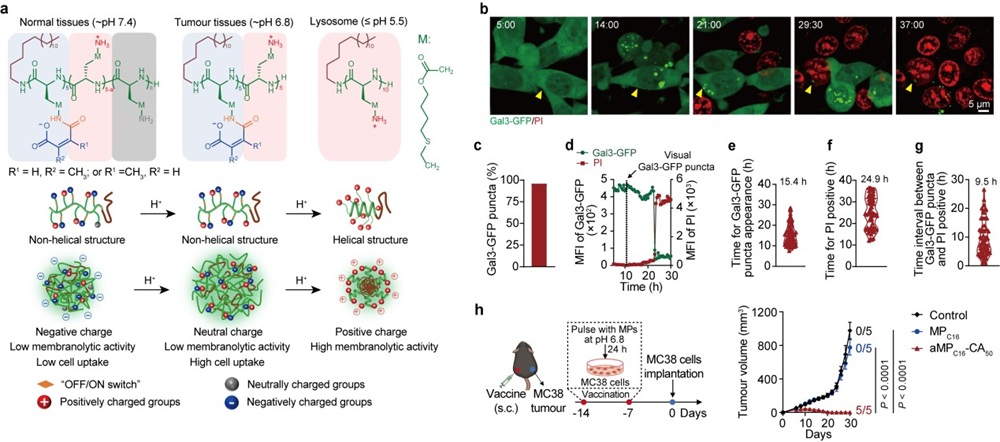
To address this challenge, the team moved beyond the conventional framework of signalling-pathway intervention and took a materials-chemistry approach, designing and synthesizing an acid-responsive membranolytic peptide, aMPC16-CA50. Acting like a "smart key," the molecule adopts a random-coil conformation and self-assembles into negatively charged nanoparticles in normal tissues (pH 7.4), remaining "silent"; upon entering the mildly acidic tumour microenvironment (pH ~6.8), its charge becomes near-neutral, promoting cellular uptake; when it reaches lysosomes (pH ≤5.5), acid-labile amide bonds are hydrolysed to release the active peptide, which refolds into an α-helical structure and restores potent membranolytic activity. Its ingenuity lies in inducing a sequential order of "lysosomal membrane rupture first, plasma membrane rupture later," with plasma membrane rupture delayed by approximately 9.5 hours. The study found that the time interval between the two membrane-rupture events is a key parameter determining the immunological outcome of cell death. This "time lag" provides a sufficient window for lysosomal contents to accumulate intracellularly and activate inflammatory transcriptional programmes, while the eventual plasma membrane rupture ensures the robust release of tumour antigens and immunogenic molecules.
Mechanistic studies showed that this temporally programmed death mode markedly upregulates immune- and stress-related genes in tumour cells (such as the IL-6–JAK–STAT3 pathway, IFNγ response, and TNF–NF-κB pathway), enhances dendritic-cell cross-presentation of tumour antigens via MHC-I molecules, and efficiently activates tumour-specific CD8⁺ T cells. Knockout of any single pore-forming gene, including MLKL, GSDME, or NINJ1, did not affect efficacy, confirming that this represents a novel, artificially programmed mode of cell death. In animal experiments, intratumoral injection of the peptide combined with systemic anti-PD-L1 antibody not only drove complete regression of injected tumours but also achieved 66–100% complete clearance of distant tumours in bilateral tumour-bearing models, with good tolerability and no evident toxicity in major organs. Single-cell transcriptomic analysis revealed that the combination therapy substantially remodelled the tumour immune microenvironment.
This study realizes a paradigm of immunogenic cell death independent of natural pore-forming proteins, providing a method to sensitize immunotherapy that does not depend on complex signalling pathways. The team is now focusing on the development of clinically translatable, industrially manufacturable membranolytic peptides, aiming to provide new strategies for cancer immunotherapy.
Article link:https://doi.org/10.1038/s41586-026-10899-5
Immune checkpoint blockade therapies, represented by anti-PD-1/PD-L1 antibodies, have been a milestone in cancer treatment over the past decade, yet objective response rates in most solid tumours remain only 20–30%. The microenvironment of many "cold" tumours lacks immune-cell infiltration, and tumour antigens are difficult for the immune system to recognize effectively; even when the immune "brake" is released, a potent response often fails to be initiated. Inducing regulated membranolytic cell death in tumour cells, such as pyroptosis and necroptosis, can enhance anti-tumour immunity, but these processes rely heavily on natural membrane pore-forming proteins such as Gasdermin and MLKL. These proteins show marked tumour heterogeneity in type, expression, and mutation, and their activation is governed by complex signalling networks that often cross-talk with immunologically silent apoptosis, resulting in unstable and difficult-to-control immunogenicity. A long-standing question has been whether cancer-cell death can be directly "programmed" by artificial molecules without relying on these natural proteins.
To address this challenge, the team moved beyond the conventional framework of signalling-pathway intervention and took a materials-chemistry approach, designing and synthesizing an acid-responsive membranolytic peptide, aMPC16-CA50. Acting like a "smart key," the molecule adopts a random-coil conformation and self-assembles into negatively charged nanoparticles in normal tissues (pH 7.4), remaining "silent"; upon entering the mildly acidic tumour microenvironment (pH ~6.8), its charge becomes near-neutral, promoting cellular uptake; when it reaches lysosomes (pH ≤5.5), acid-labile amide bonds are hydrolysed to release the active peptide, which refolds into an α-helical structure and restores potent membranolytic activity. Its ingenuity lies in inducing a sequential order of "lysosomal membrane rupture first, plasma membrane rupture later," with plasma membrane rupture delayed by approximately 9.5 hours. The study found that the time interval between the two membrane-rupture events is a key parameter determining the immunological outcome of cell death. This "time lag" provides a sufficient window for lysosomal contents to accumulate intracellularly and activate inflammatory transcriptional programmes, while the eventual plasma membrane rupture ensures the robust release of tumour antigens and immunogenic molecules.
Figure. Acid-responsive membranolytic peptides mediate a time-lagged process from lysosomal membrane rupture (LMR) to plasma membrane rupture (PMR), thereby inducing immunogenic membranolytic cell death (mLCD) in tumour cells.
Mechanistic studies showed that this temporally programmed death mode markedly upregulates immune- and stress-related genes in tumour cells (such as the IL-6–JAK–STAT3 pathway, IFNγ response, and TNF–NF-κB pathway), enhances dendritic-cell cross-presentation of tumour antigens via MHC-I molecules, and efficiently activates tumour-specific CD8⁺ T cells. Knockout of any single pore-forming gene, including MLKL, GSDME, or NINJ1, did not affect efficacy, confirming that this represents a novel, artificially programmed mode of cell death. In animal experiments, intratumoral injection of the peptide combined with systemic anti-PD-L1 antibody not only drove complete regression of injected tumours but also achieved 66–100% complete clearance of distant tumours in bilateral tumour-bearing models, with good tolerability and no evident toxicity in major organs. Single-cell transcriptomic analysis revealed that the combination therapy substantially remodelled the tumour immune microenvironment.
This study realizes a paradigm of immunogenic cell death independent of natural pore-forming proteins, providing a method to sensitize immunotherapy that does not depend on complex signalling pathways. The team is now focusing on the development of clinically translatable, industrially manufacturable membranolytic peptides, aiming to provide new strategies for cancer immunotherapy.
Article link:https://doi.org/10.1038/s41586-026-10899-5
